

Blouses, dresses, skirts, jackets, pants, shawls – you name a garment and you can make it in cotton. And you probably know all that is needed to sew with it. So one would think that this post on sewing with cotton fabric is superfluous. You may be surprised. The main reason is that cotton fibers make hundreds of cotton fabrics and they are all different – so all of them have different ways of sewing them.
Cotton knits behave totally different from cotton wovens. This post is about sewing with cotton wovens like cotton lawns, eyelet and embroidered cottons, shirtings, voile and other importantdressmaking cottons out there. Checkout Sewing with cotton knits for more details to sew with knits like interlock, jersey and rib knits.
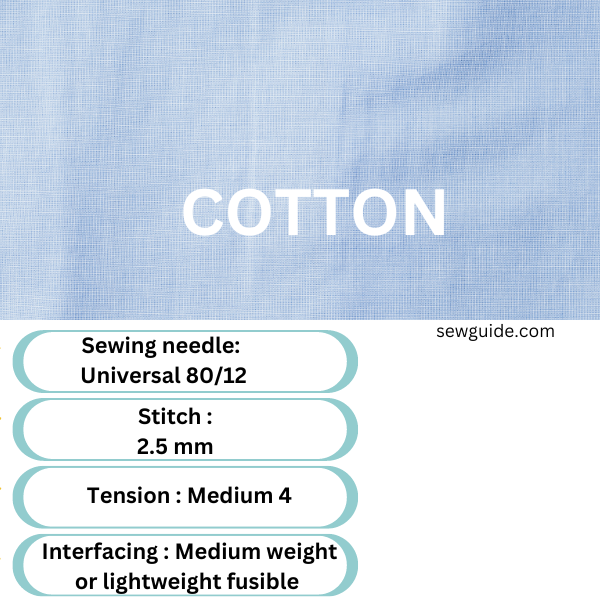
Here is a chart giving you the breakdown of the properties and sewing tips for some of the most prominent cotton types used in dressmaking.
Cotton Lawn
PropertiesWeight: 70-100 GSM. Thickness: Very Thin. Drape: Soft but crisp. High thread count with a silky feel.
Sewing DetailsNeedle: 70/10 HJ or Sharp. Interfacing: Ultra-lightweight or sheer fusible. Use fine thread to avoid seam puckering.
Cotton / Lycra Wovens
PropertiesWeight: 150-200 GSM. Thickness: Mid-weight. Drape: Stable with 2-way or 4-way stretch recovery.
Sewing DetailsNeedle: 80/12 Stretch or Universal. Interfacing: Stretch-woven fusible. Ensure interfacing has the same stretch direction as fabric.
Eyelet & Embroidered
PropertiesWeight: Varied. Thickness: Medium. Drape: Breathable with decorative perforations and low drape.
Sewing DetailsNeedle: 80/12 Sharp. Interfacing: Lightweight stable fusible. Use a press cloth to protect embroidery when ironing.
Cotton Poplin / Shirtings
PropertiesWeight: 110-140 GSM. Thickness: Medium. Drape: Crisp and structured; holds a sharp crease.
Sewing DetailsNeedle: 80/12 Universal. Interfacing: Lightweight woven fusible. Ideal for sharp collars and button plackets.
Cotton Voile
PropertiesWeight: 50-60 GSM. Thickness: Extremely Thin/Semi-sheer. Drape: Very soft and “liquid” for a woven.
Sewing DetailsNeedle: 60/8 or 70/10 Microtex. Interfacing: Ultra-sheer tricot or self-fabric. Use French seams to hide raw edges.
Cotton Denim
PropertiesWeight: 300+ GSM (10-14oz). Thickness: Thick/Heavy. Drape: Very stiff and rugged.
Sewing DetailsNeedle: 90/14 or 100/16 Denim/Jeans needle. Interfacing: Mid-to-heavy stable woven. Increase stitch length for topstitching.
Cotton Corduroy
PropertiesWeight: 200-350 GSM. Thickness: Mid-to-Heavy. Drape: Structured with a “pile” (wale) texture.
Sewing DetailsNeedle: 80/12 or 90/14 Universal. Interfacing: Mid-weight woven. Note: Cut with “nap” facing one direction to ensure color consistency.
Organza / Organdy
PropertiesWeight: 30-40 GSM. Thickness: Very Thin/Sheer. Drape: Extremely stiff and wiry (Organdy is the cotton version).
Sewing DetailsNeedle: 60/8 Microtex. Interfacing: Generally not used; use self-fabric or silk organza for support.
Related posts: More about cotton voile. ; How does cotton compare with linen ; Characteristic features of cotton
There are some things which are common for all of cottons. You have to be mindful of these to get the best out of these versatile fabrics – in all your sewing projects.
1.Buying the best cotton
If you have the best fabric your sewing job is easy already.
You will come reeling from a fabric showroom if you ask simply for “cotton” – the different names are enough to get your head in a tizzy fit. There are more than 90 types of cotton fabric available today for making clothes and other stuff.

Check out this post on the Types of cotton fabric – names.
Cotton can be woven or knit. The two common types of weaves in cotton fabrics are plain weave and twill weave.
The most important things to note when buying cotton are thread count and weight of the fabric.
Usually, when a high thread count is marked it shows that the fabric is of high quality. It will be densely woven and soft.
But there are cotton marked as of very high thread count but prove to be very rough to the touch. So very high thread count label should be taken with a pinch of salt.
Just check the weave of the cloth you have. Is it closely woven with even smooth yarns? Unless your purpose requires a loosely woven cotton, a closely woven cotton fabric is better and feels soft to the touch.
Check for starch – just scrape your fingernails across the cotton or see if the fabric has a loose weave yet looks stiff. If there is a powdery residue, this means sizing is added to give it the look it has (crisp), and this will wash off with the first wash, leaving your fabric limp and lifeless.
Most inexpensive cotton has sizing added. At first glance, the starched cotton looks very good, but once it is washed it is as limp as a rag cloth. Cotton guaze is an example of a fabric that looks good off-the-bolt, but when you wash it the look is changed.
For printed cotton in bright colours, a problem is colour bleeding. Rub a white dampened cloth across the print and see if the colour comes off. Another thing to be wary of is, will it pill?. Cotton, when blended with polyester fibers, will pill. 100% cotton does not usually pill so if you think the fabric is showing early signs of pilling, run. It will pill worse later.
There are different weights of cotton from light-weight to medium to heavy-weight and each weight is suitable for sewing different things. Buying the appropriate cotton depends on your purpose with the project, the drape you need etc
If you want a lightweight cotton fabric : Muslin, cotton voile, cotton organdy, cotton lawn, cotton batiste are your choices
If you want medium weight cotton fabric: Cotton gauze, cotton poplin, cotton damask, Chintz, sateen, cotton flannel, gabardine, gingham, cotton jersey are your choices
If you want a heavyweight cotton fabric: Cotton canvas, corduroy, velveteen, denim, toweling fabric are your choices.
Sometimes you may choose a cotton fabric for its appearance and special texture. Some are ribbed, some have piled construction, some come with dots woven into it, some have a puckered surface.
If you are concerned about the chemical exposure in cotton fabrics (some of the most carcinogenic chemicals are involved in the manufacturing of cotton textile) buy Organic cotton which is certified to be pure.
Medium weight printed fabrics are slightly crisp and is not drapey on the body – so if you want a flowy fabric this is not for you. But a trick to make it drapey enough is to use a silky lining.
I have added the gsm of different cotton fabrics here (other than the ones added above) – You must have noticed that as the gsm goes up the thickness of the material also increases.
| Fabric | GSM |
|---|---|
| Chambray (Light) | 100 – 130 GSM |
| Quilting Cotton | 140 – 180 GSM |
| Cotton Jersey (T-shirt) | 130 – 200 GSM |
| Cotton Flannel | 150 – 250 GSM |
| Cotton Drill | 240 – 300 GSM |
| Cotton Canvas / Duck | 350 – 550 GSM |
2.Pre-treatment of cotton fabric
Cotton fabric is usually finished with a lot of starch /sizing. Before attempting to sew with it you will have to necessarily prewash it – otherwise, after you sew and you wash it, the garment will shrink. Pre-Wash as you plan to wash later.
Remove all wrinkles by pressing the fabric before marking the fabric for cutting.
3.Select needles
Normal sharp-point needles can be used to sew cotton fabrics.
Universal needles in sizes 80/12 can be used for medium weight cotton fabrics and 70/10 are best for sewing thin cotton fabrics.
For heavier weight cotton fabrics use 90/14 or100/16 needles.
120/20 needle is used for very heavy cotton fabrics.
For cotton knits, use a ballpoint needle for better control and smooth sewing.
4.The best thread for sewing cotton
You can use with them all – cotton, cotton/polyester, polyester, or even silk thread – all can be used to sew cotton fabric.
To be more specific and discerning – For cotton without any stretch, 100% cotton thread is usually enough. For fine cotton fabric like cotton lawn, use all cotton thread.
If the cotton fabric has lycra or if it is a cotton knit, use polyester thread or cotton/polyester thread.
5.Cutting cotton
If the cotton you have does not have a correct grain, it will not lay properly on the body, the prints and patterns will not align properly. As you buy the fabric this has to be checked.
Find out more about how to find the grain of the fabric here.
6. Seams and hems of cotton garments
You can sew cotton with the regular straight seams – set the stitch length at 2.0 or 2.5. 2.5 is good for medium weight fabrics but for finer cotton use a shorter stitch like 1.5 or 2.
For cotton cut on the bias ( which stretch) or includes bias cut edges, like in an A-line skirt side edges, I would use a short zig-zag stitch, for its stretch (2.5 length, 2.0 width) to help prevent stretching and distortion. Whenever I have used straight stitch on such seams they pop or look wiggly.
Cotton fabric usually frays, so finishing the cut fabric edges is absolutely necessary for a neat finish inside the garment. Here are the different ways to finish the edges of fabric.
The easiest way is of course to use pinking shears. The zig-zag edges you get when you cut with pinking shears will finish the edges enough for most cotton.
The seam edges can also be perfectly finished with a serger. Edges finished with bias binding is also beautiful and regularly used by professionals.
For sheer/ almost sheer cotton fabrics use a french seam inside so that the seam edges are neatly enclosed. Check out this post on working the french seam
Hand stitched hem is best for thin drapey cotton fabrics. Rolled hem also works. For regular weight cotton, a double-folded topstitched hem is used. Cotton is crisp and looks neat however it is sewn
7. Interfacing & lining
Even cotton fabric needs interfacing (though you may not think so) especially for collars, pockets, waistbands, facings and even hems. Fusible interfacing (woven interfacing can be used for cotton woven fabrics and for cotton knits use a knit interfacing).
Sew-in interfacing can be used for thin cotton fabrics; If you want fusible use very thin interfacing. Fabrics like batiste, organza, or muslin cut on the bias are used as sew-in interfacing for thin cotton.
For medium weight cotton, a suitable weight sew-in interfacing can be used instead of fusible. Cotton organdy or batiste can be used this way.
If lycra fiber is included in your cotton fabric you will have to use interfacing that does not need to be heat set.
Learn more about the what kind of interfacing to use.
8.Pressing cotton fabric
Pressing is a very important element in sewing cotton. Because of its crisp nature you have a dream fabric to sew when you press as you sew. Usually finger-pressing can be done but a hot iron near where you sew cotton is always a bonus.
See more pressing tips here
One disadvantage anyone can spot in cotton garments is that it wrinkles a lot – especially the thin and medium weight cotton.
You can steam press cotton fabric to a crisp look very fast enough, unlike linen which is a little difficult to iron.
Cotton can take a lot of heat unless it has elastic/lycra fibers. If lycra fibers are there in your cotton fabric as per the clothing label or if the fabric you have has a stretch (without it being a knit) avoid high heat.
9.Embroidery on cotton fabric
Cotton looks beautiful when embroidered. But you will have to remove all sizing by prewashing and use suitable stabilizer before embroidering especially if the fabric is thin or has lycra added to it. On garments, the regular places where embroidery is placed are hems, pockets, collars, and cuff areas.
Check out the post on hand embroidering on clothes
10. Storing & Maintaining cotton fabric
Cotton fabrics are usually low maintenance. They can be washed and dried in a washing machine/dryer without too much botheration unless a sewing /design consideration like embroidery and other embellishments dictate otherwise.
If lycra is added to the cotton fabric, you will have to avoid the heat in the dryer. Ironing these fabrics also require more care and a cooler iron settings.
Colour retention of cotton is usually good but some colored cotton fabrics bleed and some fade fast. For colour retention, many tricks like prewashing in water mixed with salt etc are vouched by many. If your cotton fabric has many bright coloured patterns one risk you take is tinting of adjacent areas with colour from the prints.
Avoid drying cotton clothes in sunlight for a long time – this will prevent colour fading. Remember that cotton needs to be fully dry especially if it has been starched – the smell of moldy cotton is horribly stinky. Avoid this if you care anything for the quality of your life.
Related post: If you want to know other sewing tips for other fabrics checkout these articles.


Great article. Informative and well written. Thank you.